
Fireworks types and effects
Every kind of consumer firework, what it actually does in the air or on the ground, and what the numbers printed on the box are telling you. The diagrams are drawn to show the shape of each effect, not to scale.
Photo: Zaonar Saizainalin, via Pexels
Figures drawn from our own catalog of 10,845 products. Last built 2026-08-28.
Cakes
200 gram cakes
A cake is one box with a bank of tubes fused together inside it. You light one fuse and the box fires a set sequence by itself. The gram number is the pyrotechnic composition packed into the box, not the weight of the carton, so a 200 gram cake carries less lift and less payload than a 500.
- Shots leave in a fixed pattern, most often straight up or in a shallow fan.
- Breaks sit lower and smaller than a 500 gram cake fired next to it.
- The whole item is usually over in well under a minute.
- Good for filling the gaps between larger items rather than carrying a segment on their own.
- Shot count on its own says little. A 25 shot cake that empties in 12 seconds and a 25 shot cake that takes 45 seconds are different products, so read shots and duration together.
- Often the cheapest way to add a specific color or effect you are missing.
350 gram cakes
An in between size that some manufacturers build and others skip entirely. Construction is identical to any other cake. The extra composition over a 200 buys a little more height and a little more payload per shot.
- Noticeably taller than a 200 gram cake, close enough to a 500 that the difference shows mostly in the size of the break.
- A thin category. If your local stand does not carry them, nothing is lost, because a 500 gram cake covers the same job.
- Worth checking the price per shot against the 500 gram cakes beside it, since the middle size is not always priced in the middle.
500 gram cakes
The workhorse of consumer fireworks and the largest part of this catalog by far. Industry practice builds a single consumer cake up to a 500 gram composition ceiling, so this is as much as one box normally carries. Anything heavier on the shelf is usually two or more cakes fused into one carton.
- The full range of consumer effects: straight rows, fans, Z patterns, crossettes, willows, strobes and a fast tail at the end.
- Most are built to accelerate, so the last two seconds fire faster than the first ten.
- This is the size to build a show around. Openers, body and finale can all be 500 gram cakes.
- Duration matters more than shot count once you are planning a running order. A 100 shot cake that lasts 25 seconds fills a segment; a 100 shot cake that lasts 8 seconds is a finale piece.
- Two cakes with the same shots and the same seconds can still look different, because a fan spreads the sky and a straight cake stacks it. Read the effect description, not just the numbers.
Compound and finale cakes
Sold as 1000 gram, 1500 gram or simply as a finale, these are several cakes packed and fused as one unit. You light one fuse and the whole carton runs. They exist because a single cake is held to the smaller ceiling, so more product means more boxes joined together.
- A long build, then a heavy overlapping section where two or three of the internal cakes are firing at once.
- Wider coverage than a single cake, because the internal units are usually angled away from each other.
- One compound cake can replace an entire hand fired finale sequence, which matters if you are shooting alone.
- Check the footprint. These cartons are wide and need a flat, stable base and more clear space downrange than a single cake.
- Price per second, rather than price per shot, is the fairer comparison against a set of separate cakes.
Slices and fan cakes
Same construction as a cake, but the tubes are angled outward rather than set upright, so the shots spread sideways instead of stacking overhead. A slice is a single row. A fan or fan rack spreads wider still.
- A wall or a sweep of effect across the sky rather than a column of breaks in one place.
- It is over quickly. These are built for width, not for run time, and the catalog bears that out.
- Use them for punctuation. One slice under a longer cake makes the whole sky look wider than either item does alone.
- They eat horizontal space. Check what is downrange on both sides before you set one.
- Judging a slice on duration will always make it look like poor value. Judge it on the picture it makes.
Aerial single shots
Artillery shells
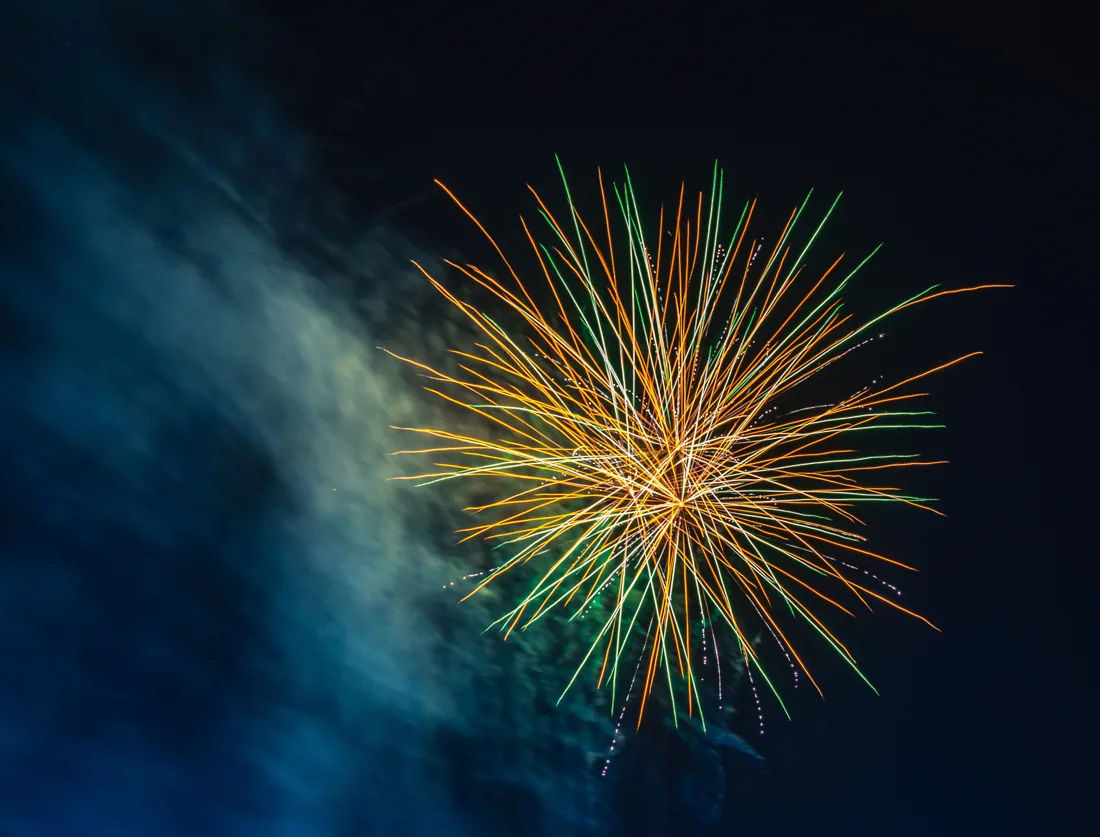
Photo: Robert Kso, via Pexels
A reloadable kit: one or more heavy tubes plus a box of separate shells. You drop a shell in, light it, let it fire, and load the next one. Each shell is a single break, and it is the closest a consumer product gets to a professional aerial shell.
- One rising tail, then one large symmetrical break, well above anything a cake produces.
- Canister shells break wide and round. Ball shells break tighter. Both are sold in consumer kits.
- The best height for the money in most stands, which is why they carry so much of the shelf space.
- Never reload a warm tube by leaning over it, and never use a tube that has been cracked or scorched through. The tube is the part of the kit that fails.
- Shell count is the number you are buying. Kits are often sold with more shells than tubes.
Single shot pro items: comets, mines and bulk shells
These come out of the 1.4G professional line, which is consumer classified product built for people shooting a real show. A comet is one thick rising star with a tail. A mine fires its whole payload out of the tube at once in a wide cone from the ground. A bulk shell is a shell sold without a tube, for someone who already owns racks.
- Comet: a single bright climb, sometimes with a small break at the top, sometimes just the tail.
- Mine: an instant, wide, ground level spread. Nothing rises, everything opens at once.
- One shot, over in a few seconds, which is exactly what the catalog records for them.
- These are show building blocks, not stand alone products. On their own they look like very little for the money.
- Mines are the cheapest way to give a show a hard start, because the audience sees the whole effect from the first frame.
- Bulk shells assume you own tubes rated for them. Do not fire a shell out of a tube it was not sold for.
Missile batteries
A rack of small stick free missiles, each one screaming upward on its own motor and popping at the top. Shot counts here are the highest numbers in the whole catalog, because the individual missiles are tiny.
- A fast, noisy, scattered climb. The missiles do not fly straight and they do not all go the same way.
- Very little color. The effect is noise and motion.
- High shot counts on the box are not comparable to a cake's shot count. Two hundred missiles is not two hundred aerial breaks.
- Because the flight path is not reliable, these want more clear space and more distance than the box size suggests.
- The catalog records burn times for too few of these to publish a figure.
Rockets
A stick stabilised item that flies once and breaks at the top. Bottle rockets are the small end of the family and are specifically banned in a number of states that otherwise allow aerials, so this is a category to check your own state on before buying.
- A single climb on a visible tail, then one break, usually smaller than an artillery shell.
- The stick comes back down, which is a reason to think about where you are standing.
- Legality is the first question, not the last. Several states name rockets and spinners as the excluded items.
- They must be launched from a stable rack or tube, not thrown or hand held.
- Our catalog records no shot counts or burn times for rockets, so no figures are shown here.
Ground items
Fountains
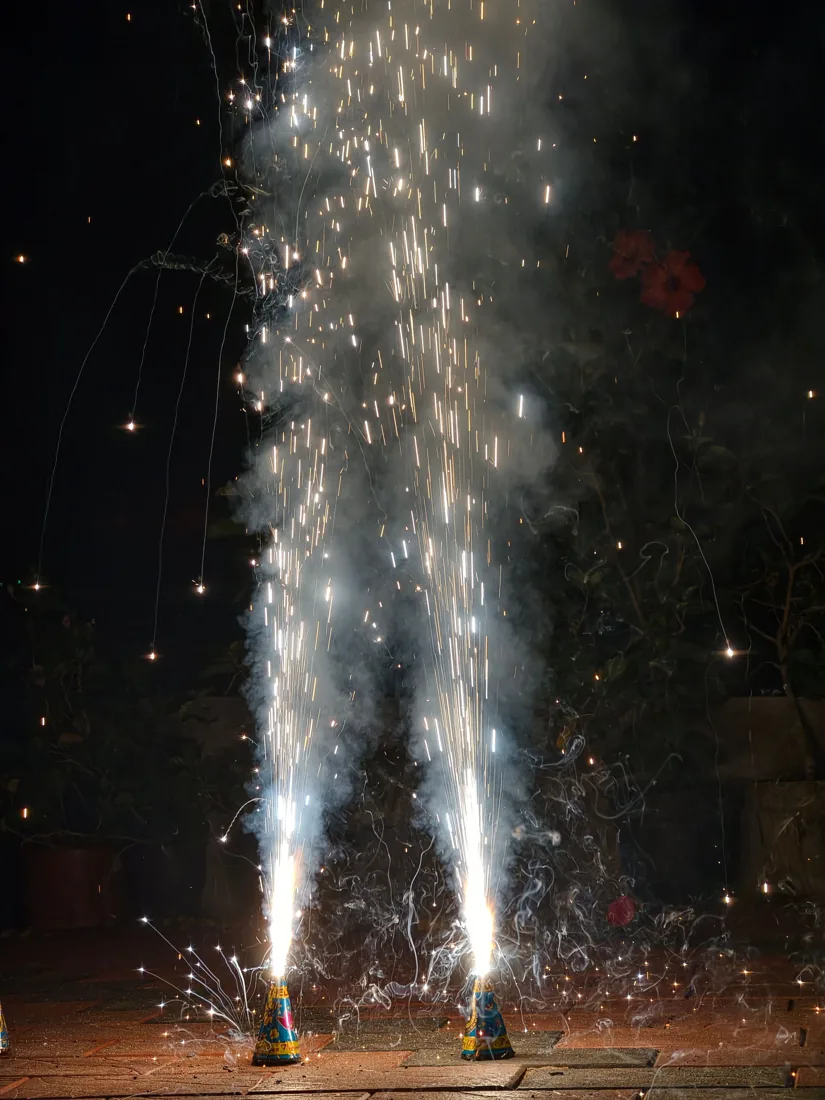
Photo: Bliss, via Pexels
A ground item that sprays sparks upward in a cone and never leaves the ground. Because nothing goes airborne, fountains are legal in more places than any other real firework, and in a number of states they are most of what a consumer can buy.
- A steady cone of sparks, often changing color partway through, sometimes with crackle at the end.
- The longest single burn of anything in the catalog. The typical fountain outlasts the typical 500 gram cake several times over.
- The best value per second in most stands, and the safest item to place close to an audience within its own rated distance.
- Height varies enormously between a small cone and a large tube fountain. The word fountain alone tells you very little.
- Shot count is not a meaningful measurement for a fountain and our catalog rarely records one.
Smoke
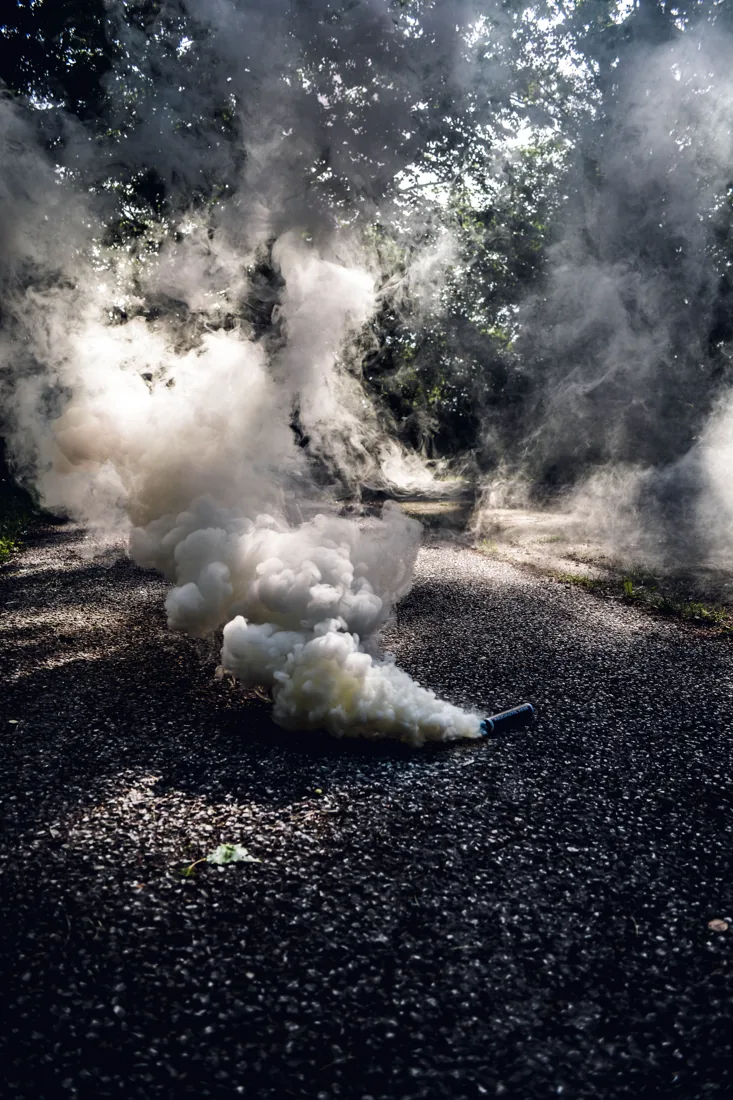
Photo: lilartsy, via Pexels
Colored smoke, made for daylight rather than dark. Used for daytime events, photography and as a cover effect between aerial segments.
- A dense colored cloud that drifts with whatever wind you have. In still air it sits and pools.
- No noise, no light, no aerial component.
- Wind decides whether this works at all. In dead calm the smoke does not clear and it will sit in front of everything you fire next.
- Color staining on clothing and light colored surfaces is common. Set them away from cars and seating.
- The catalog records burn times for too few smoke items to publish a figure.
Spinners and girandolas
Items that turn rather than travel. A ground spinner sits and spins where you put it. A girandola spins up into the air on its own thrust and climbs while turning.
- A tight circle of sparks on the ground, or a rising ring of light that wanders as it goes up.
- The flight path of anything that climbs while spinning is not predictable.
- Spinners are named alongside rockets in several state exclusions, so check your state first.
- A ground spinner needs a flat hard surface. On grass or gravel it will stall, tip or wander somewhere you did not intend.
- Too few of these carry recorded shot or duration values for a figure to be published.
Novelties and small items
Roman candles
No shot count or burn time is published for this type, because our own catalog does not record enough of them to state one honestly.
A single tube that fires a sequence of individual stars, one after another, from one fuse. The stars are usually large and slow enough to follow with your eye, which is why the effect reads so clearly at close range.
- A regular beat of single balls of color, evenly spaced, climbing on roughly the same line.
- Between five and ten shots on most consumer candles, with the count printed on the tube.
- Stake or brace them. A roman candle that tips while firing points the remaining shots at whatever is in front of it, and hand holding is how most roman candle injuries happen.
- They are among the first items limited or banned when a state restricts anything, so check your state.
Firecrackers
No shot count or burn time is published for this type, because our own catalog does not record enough of them to state one honestly.
Noise with no visual payload, sold as strings, bricks and rolls. What varies between products is the count in the pack and how tightly the string is braided, which is what decides whether you hear individual reports or one long roll.
- A rolling crackle from a string, or single sharp reports from loose crackers.
- Nothing in the air, and almost nothing to look at after dark.
- Hanging a string clear of the ground makes it sound like a string. Left in a pile it half smothers itself.
- This is the category most likely to draw a noise complaint and most likely to be restricted by a city that allows everything else.
Sparklers
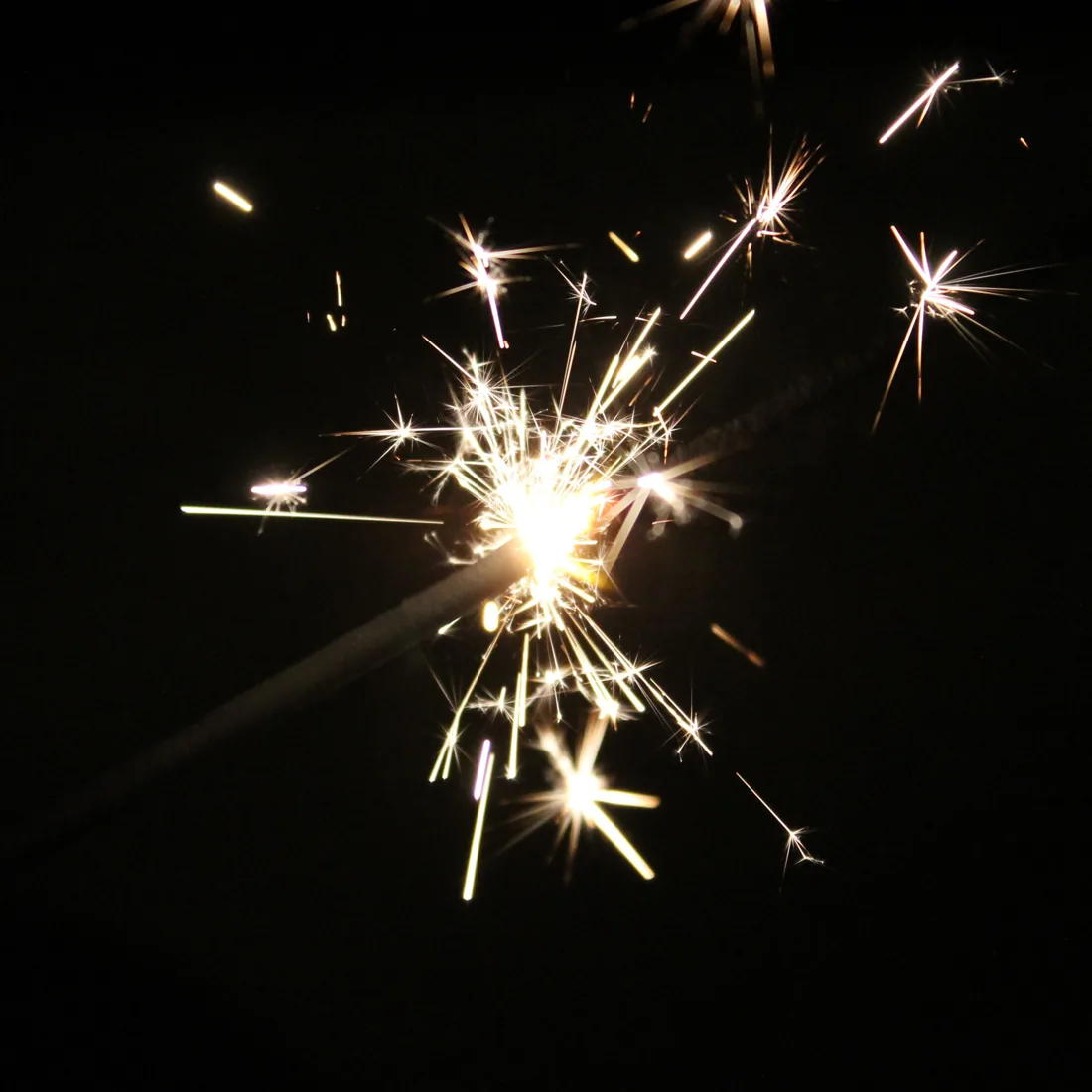
Photo: Marije Kouyzer, via Pexels
No shot count or burn time is published for this type, because our own catalog does not record enough of them to state one honestly.
A coated wire or wooden stick that burns in place, held in the hand. In several states that allow nothing else, sparklers and a short list of novelties are the entire legal category.
- A steady ball of sparks at the tip, burning down the wire over roughly a minute for a common size.
- Wire sparklers burn hotter and cleaner than wooden ones and stay hot after the flame is gone.
- Despite the reputation as the harmless item, sparklers are consistently reported among the leading causes of consumer fireworks injuries, largely because they are handed to children and because the wire stays hot.
- Have a bucket of water for spent wires. Dropping them on grass is how people get burned an hour later.
Ground novelties
No shot count or burn time is published for this type, because our own catalog does not record enough of them to state one honestly.
The small items that fill the front of a stand: ground spinners, snakes, poppers and snaps, smoke balls, parachutes, tanks and the rest. Individually they do very little. As a category they are what a family with young children actually uses, and in limited states they are often all that is on offer.
- Small, close, ground level effects meant to be watched from a few feet away in daylight or dusk.
- Parachutes and tanks are the two that still surprise people who have not seen them since childhood.
- Read the state rules before assuming these are exempt. Novelty is a marketing word, not a legal category, and states draw the line in different places.
- Snaps and poppers are usually the only item sold with no fuse at all, which is why they end up in the hands of the youngest children present. They still contain a small charge.
Buying in one box
Assortments
A pre-packed carton holding a spread of separate items, usually a mix of cakes, fountains, candles and novelties, sold as one unit. The whole point of an assortment is that somebody else chose the running order for you.
- Whatever the packer put in it. Two assortments at the same price can hold very different products.
- The shot count printed on the carton is the sum of every item inside, which is not comparable to a single cake's shot count.
- Compare the item list, not the headline shot count or the crossed out price on the box.
- Assortments are where slow moving stock goes. A carton heavy on novelties and light on 500 gram cakes is cheap for a reason.
- If you already know what you want, buying the individual items is usually the better show, though rarely the lower price.
Every type side by side
Typical means the middle value across the products we hold of that type. Types with too little recorded data are shown as not recorded rather than estimated.
| Type | Family | Typical shots | Typical run | Products held |
|---|---|---|---|---|
| 200 gram cakes | Cakes | 16 | 27 sec | 1,336 |
| 350 gram cakes | Cakes | 25 | 33 sec | 75 |
| 500 gram cakes | Cakes | 25 | 32 sec | 2,752 |
| Compound and finale cakes | Cakes | 45 | 28 sec | 292 |
| Slices and fan cakes | Cakes | 13 | 2 sec | 279 |
| Artillery shells | Aerial single shots | 12 | not recorded | 773 |
| Single shot pro items: comets, mines and bulk shells | Aerial single shots | 7 | 3 sec | 665 |
| Missile batteries | Aerial single shots | 200 | not recorded | 93 |
| Rockets | Aerial single shots | not recorded | not recorded | 23 |
| Fountains | Ground items | not recorded | 60 sec | 534 |
| Smoke | Ground items | not recorded | not recorded | 40 |
| Spinners and girandolas | Ground items | not recorded | not recorded | 14 |
| Roman candles | Novelties and small items | not recorded | not recorded | not in this data set |
| Firecrackers | Novelties and small items | not recorded | not recorded | not in this data set |
| Sparklers | Novelties and small items | not recorded | not recorded | not in this data set |
| Ground novelties | Novelties and small items | not recorded | not recorded | not in this data set |
| Assortments | Buying in one box | 64 | 40 sec | 421 |